- Docs
- Concepts
Governance Metrics and Board Packs
How the governance itself is performing — lead time, recycling, position latency, realisation, conditions, exception ageing, the conformance trend and coverage — computed from the records over a stated period, and the signed board pack a chair or secretary prepares from them.
#Why Governance Metrics
A head of architecture reports to a board on the function's own performance as well as on the estate's: how fast reviews and decisions are decided, how often designs come back, how old the exceptions are, which way conformance is moving. Those numbers are usually rebuilt by hand in slides each quarter. In Archigov they are computed from the records the governance already runs on — reviews, positions, decisions, conditions, exceptions, evaluation runs and the registers — so every figure rests on rows anyone can open, and the period is always stated.
A board pack takes those figures to a sitting. It is signed and chained exactly like the evidence pack, so anyone can check after the meeting that the figures are what Archigov held. Like everything else in Archigov, it shows evidence and who stands behind it, and asserts nothing.
#The Period
Every figure is computed for a period: the last 30, 90, 180 or 365 days, chosen with Period on the page (90 by default). Through the API, GET /api/metrics?days= takes anything from 7 to 730 days and clamps a value outside that range to it. The API response, the page and every board pack state the period and the date it starts.
Some figures count what happened in the period: reviews declared, decisions accepted, conditions met, findings fixed. Others describe the records now: open reviews, open findings, active exceptions, realisation, coverage, risks and debt. The tables below say which.
#The Figures
Every figure is a count, a median or a 90th percentile over records. Durations are in days, to one decimal place; a median or percentile falls between the two nearest values when it has to.
#Reviews
| Figure | How it is computed |
|---|---|
| Decided | Reviews whose outcome was declared in the period, with the number open now (submitted, in pre-review, in review or with changes requested) and the age of the oldest open one |
| Lead time | From submission to the declared outcome, for the reviews declared in the period: median and 90th percentile, overall and by review type |
| Recycled | The share of reviews declared in the period that were sent back at least once — changes requested or resubmitted, on the record |
| Fast lane | Approving declarations in the period, including those on a consent agenda, whose record says they rested on the fast lane — out of all approving declarations in the period |
| Position latency | From a review's submission — or its resubmission, when the position came after it — to each position recorded in the period: median and 90th percentile |
#Decisions, Conditions and Exceptions
| Figure | How it is computed |
|---|---|
| Decisions accepted | Decisions accepted in the period, with the time from draft to acceptance (median and 90th percentile), and the number still proposed now |
| Realisation | From the roadmap, now: how many decisions are realised, in progress, not started or not checkable |
| Conditions | Open now; overdue now (marked overdue, or open past their due date); met in the period; met on time — the share of those met in the period with a due date that were met by it; and the days from being set to being met (median and 90th percentile) |
| Exceptions | Active now, by how long ago they were granted — 0–30, 31–90, 91–180 and over 180 days; how many expire within 30 days; how many have no expiry; and how many have expired |
#Conformance
| Figure | How it is computed |
|---|---|
| Open findings trend | For each day in the period with an evaluation, the last run of that day: the open findings, by severity |
| Opened and resolved | The findings opened and resolved in the period, as the evaluation runs recorded them |
| Time to fix | From a finding's first sighting to its resolution, for the findings resolved in the period: median and 90th percentile |
| Open findings | Open now, by severity, with the age of the oldest |
#Coverage
| Figure | How it is computed |
|---|---|
| Human verified | Applications, resources, relations, decisions and AI outputs a named person has verified, of all of them; the page shows applications and decisions |
| Classified | Applications with a criticality, of all applications, and how many of those classifications a person has verified |
| Legacy assessments | Applications whose yearly legacy assessment is in date and not stale, of the applications that need one |
| Exit plans | Exit plans in date, of the reliances that need one |
| Reaffirmations | Adopted catalogue items and accepted decisions whose reaffirm-by date has not passed, of all of them, with how many are overdue and how many are due soon. A Reaffirmations tile on the page (linked to the Reaffirmations page) and Items in date for reaffirmation in the board pack's Coverage table |
#Risks and Debt
| Figure | How it is computed |
|---|---|
| Open risks | Risks on the risk register that are open now, with how many are accepted and how many proposed |
| High or critical | Open, accepted and proposed risks rated high or critical, now |
| Review overdue | Risks whose review date has passed while they are open or accepted, now; the tile also says how many risks on the register stand for active exceptions |
| Architecture debt | The architecture debt items the records show now, counted by kind in the API |
The response also carries the Legacy Register's counts, the concentration on each provider and the roadmap's counts per lane.
#Not Available, Never Zero
A figure with nothing behind it — a median with no durations to take it over, a share with nothing to divide, the oldest of none — is null in the API, a dash on the page and not available in a board pack. It is never reported as zero. A count is a count: no review declared is 0.
#Figures, Not Verdicts
No figure is coloured, flagged or labelled good or bad, and none is measured against a target. What a lead time or an exception's age means is for the board to decide.
#The Governance Metrics Page
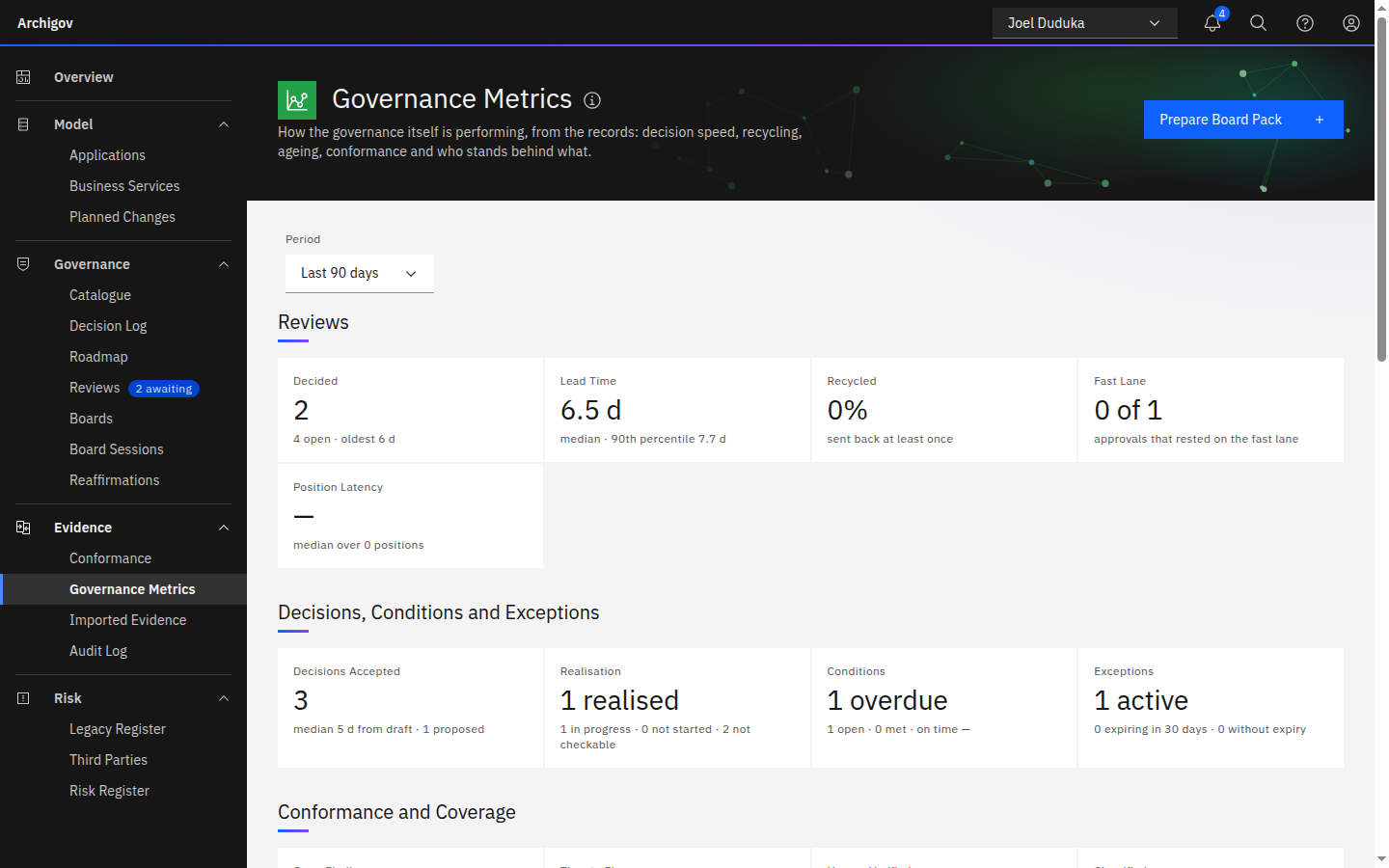
Evidence → Governance Metrics brings it together:
Period — the last 30, 90, 180 or 365 days.
Figure tiles in four groups — Reviews; Decisions, Conditions and Exceptions; Conformance and Coverage; Risks and Debt — each with a line saying what it counts. The Legacy Assessments and Exit Plans tiles link to the Legacy Register and Third Parties, and the Open Risks and Architecture Debt tiles to the Risk Register.
Charts:
- Reviews decided per month — bars;
- Median review lead time — a line with one label per month, drawn only through the months that declared a review: a month that declared none has no median, so it is a gap, not a zero;
- Open findings over time — the trend over the period, by severity, as on the Overview;
- Active exceptions by age — bars over the four age buckets.
The two monthly charts cover the last six calendar months, whatever the period. Counts and durations are drawn in one neutral hue, because none of them is good or bad in itself. Count axes use whole numbers, so no tick reads as a fraction of a review, and the bar and line charts repeat their values in words beneath them. Where there is not enough to draw a trend — fewer than two months that declared a review, or fewer than two days with an evaluation in the period — the chart says so instead of drawing a line.
Board Packs — every signed pack: its title and board, the period, whether it has a narrative and where the narrative came from, who prepared it and when, and the start of its hash.
Prepare Board Pack — in the hero band, for a board's chair or secretary.
#Board Packs
#What a Pack Contains
A board pack is a snapshot, built from the records at the moment it is signed:
- the title (by default Board pack — October 2026, for the month it is signed), the tenant, the board if one was chosen, the period, and who prepared it and when;
- the narrative, if the preparer wrote one, with its origin and author (see The Narrative);
- every figure above, for the period;
- the decisions decided in the period, each with its status;
- the reviews declared in the period, each with its type, outcome, board and date, marked where the approval rested on the fast lane;
- the roadmap: the counts per lane and every item in Now, with its kind, status, due date and applications;
- the register gaps: applications whose legacy assessment is due or stale, with their legacy components; the exit plans due, by application and provider; and the concentration on each provider, naming the designated critical third party where there is one;
- the risks needing attention: open and accepted risks rated high or critical, and any risk whose review is overdue, each with its severity, status, owner, review date and the decision that accepts it, with the risk register's counts;
- a disclaimer: the pack summarises the records held for the period stated; it shows evidence and who stands behind it, and does not assert compliance with any regulation or standard.
When the preparer chooses a board, the reviews in the pack are that board's; the figures, the decisions and everything else stay tenant-wide. All boards keeps every review.
#Preparing a Pack
A board's chair or secretary chooses Prepare Board Pack on the Governance Metrics page and fills in:
- Period — 30, 90, 180 or 365 days, starting from the page's period.
- Board — a board they chair or are secretary of, or All boards.
- Title — optional.
- Narrative — optional, and the only part anyone writes.
Sign Board Pack builds the pack from the records, signs it and opens it. Nobody else can prepare one: the platform admin, the auditor, a decision maker, a reviewer and an author without a chair or secretary seat are refused with 403, and the button is not offered to them.
#How a Pack Is Signed
A board pack is hashed, chained, signed and kept by the same code as the evidence pack:
- its content is serialised as canonical JSON and hashed with SHA-256;
- it records the chain head — the hash of the latest audit row — and the number of audit rows, anchoring it to a point in the audit chain;
- it is signed with the instance's Ed25519 key, and the public key travels inside it;
- it is persisted under
DATA_DIR/evidence-packs/, named by its hash, beside the evidence packs, with an index row for the Board Packs list; - its creation is audited as
board_pack:create.
Anyone who can read board packs checks one with the same call as an evidence pack:
GET /api/evidence-pack/verify?hash=<sha256>It re-checks the content hash, the signature and the audit chain up to the recorded head. A third party can also verify a downloaded pack independently with the instance's published public key, exactly as for the evidence pack (see Exports).
A pack is never recomputed. Its page shows it as signed, even after the records behind it have moved on; a new period, or a different narrative, means a new pack.
#Reading a Pack
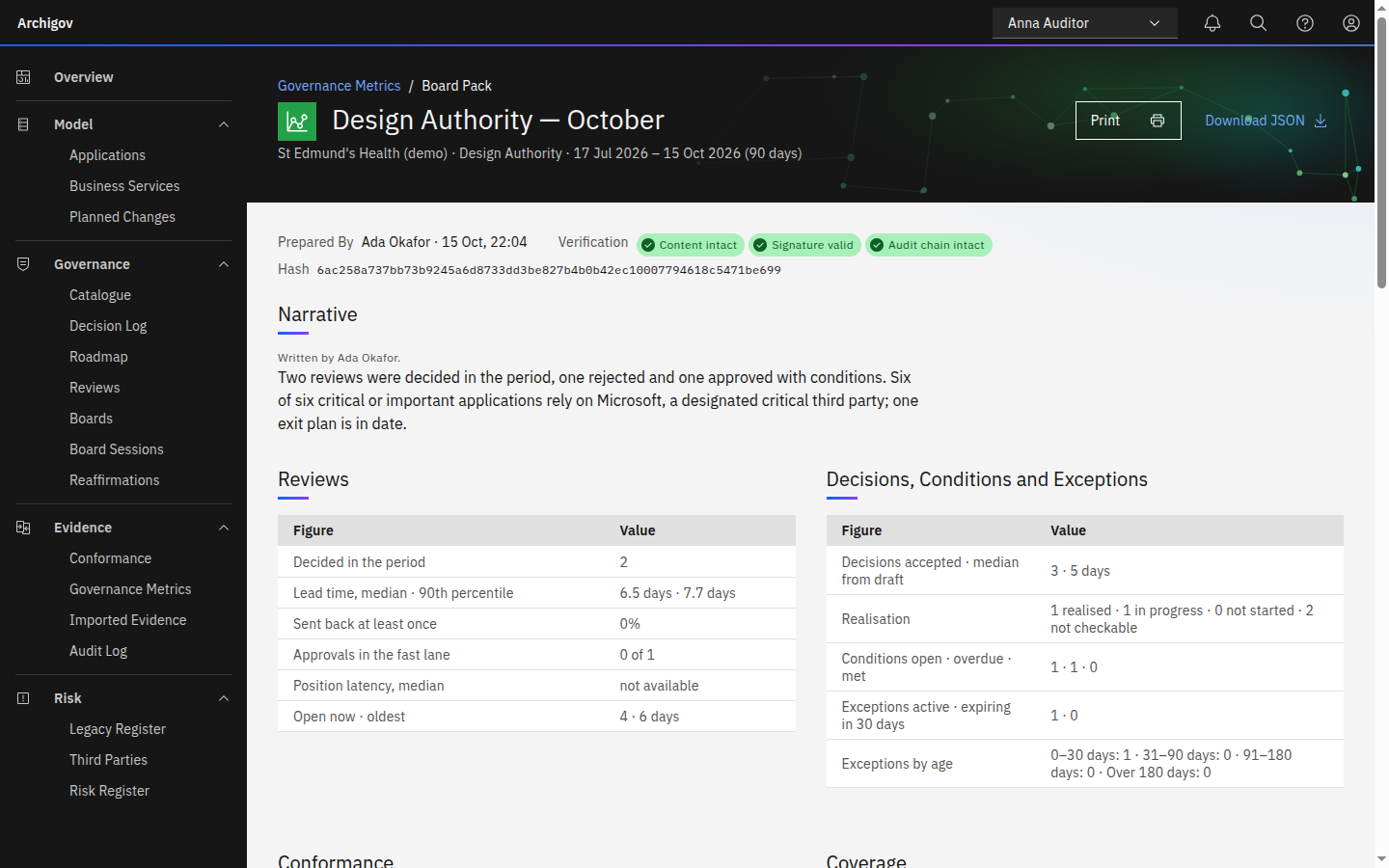
Open a pack from the Board Packs list. It is laid out to be read in a sitting and printed:
- Prepared By, the verification — re-checked every time the pack is opened, as three status tags: Content intact, Signature valid and Audit chain intact — and the full hash. If any check fails, an error notification says the pack does not verify and should not be relied on.
- Narrative, with a line naming who wrote it, or saying it was drafted with AI from the figures and edited and submitted by the preparer.
- Figure tables for reviews; decisions, conditions and exceptions; conformance; and coverage. A missing figure reads not available.
- Decisions in the Period (every decision decided in the period, with its status), Reviews Declared in the Period (with each outcome and a Fast Lane tag where the lane carried the approval), Roadmap · Now, Risks Needing Attention and Register Gaps.
- The disclaimer, with the verify call.
Print prints the pack as a document, without the application's navigation or the hero band's decoration. Download JSON downloads the signed pack (archigov-board-pack-<first 12 characters of the hash>.json) to hand to anyone who wants to verify it.
#The Narrative
The narrative is the only authored part of a pack: what the preparer wants the board to take from the figures. It is optional; without one, the pack says the preparer added none. The pack records it with its author and its origin:
human— written by the preparer;ai_assisted— drafted with AI and then edited and submitted by the preparer. Once a draft has been used in the form, the narrative is recorded as AI-assisted, however much the preparer changed it.
The Board Packs list shows each pack's narrative origin.
#Who Can Do What
| Who | Can |
|---|---|
| Everyone who can read the model | See Governance Metrics (GET /api/metrics) |
Authors, auditors, every board seat and the platform admin (capability export_evidence) | List, read, download and verify board packs |
| A board's chair or secretary | Prepare a board pack; ask for an AI draft of its narrative |
Preparing a pack, or asking for a draft, is admitted at the route for manage_board or decide_review, and the handler then checks for a chair or secretary seat. The platform admin, the auditor, a decision maker, a reviewer and an author with no chair or secretary seat are refused with 403. See Roles and capabilities.
#Evidence and Audit
The figures are computed when they are read; viewing them writes nothing. Preparing a pack writes board_pack:create to the audit chain, with the hash, the title, the period, the board and the narrative's origin. The pack itself is the signed record of what was put before the board. See the HTTP API for the endpoints.
#Heuristics and AI
Every figure is deterministic: a count, a median or a 90th percentile over records anyone can open, for a stated period. No AI computes, rounds, fills in or comments on a figure.
AI is optional and only narrates. Board Pack Narrative is a per-feature switch under Settings → AI, off by default (see AI providers). With it on, Draft with AI in the Prepare Board Pack form drafts the narrative from the pack's figures for the chosen period, and only from them:
- every statement must quote a figure;
- a missing figure is called not available, never estimated;
- no judgement — nothing is called good, bad, compliant or non-compliant.
Nothing is stored when a draft comes back: it fills the Narrative box, and the chair or secretary edits it and signs the pack as their own. With the feature off, the button is greyed with the reason, and the API answers 409. A model never prepares, edits or signs a pack. See AI in Archigov for what is sent.
#What It Deliberately Does Not Do
- It does not set targets or colour a figure against one. The board decides what a figure means.
- It does not edit a pack after signing. A different narrative means a new pack.
- It does not recompute a pack. A pack shows the snapshot as signed; a new period means a new pack.
- It does not let a model prepare or sign a pack. AI drafts a narrative for a person to submit, and nothing more.
Note
Governance metrics and board packs show what the records say about how the governance is working, and who prepared each pack and when. Archigov never asserts that a figure shows compliance with any regulation or standard: it shows evidence, not assurance.
Something unclear or out of date? Write to hello@archigov.com or open an issue on GitHub.