- Docs
- Concepts
Conformance and Findings
Continuous evaluation of adopted rules and decision constraints against the derived model and imported evidence — findings that persist, exceptions that expire, and diffs per run.
#What Is Evaluated
Every adopted catalogue artefact with a rule is evaluated by one engine against the derived model and imported evidence. Rules come in two scopes:
- Resource rules check each matching resource — a property, imported evidence, or the constraint of an accepted decision.
- Application rules check each application — that it has an accepted decision on a topic, an owner tag, or no more than a number of resources of a type.
See the Rule DSL for the full grammar and Writing rules for a walkthrough.
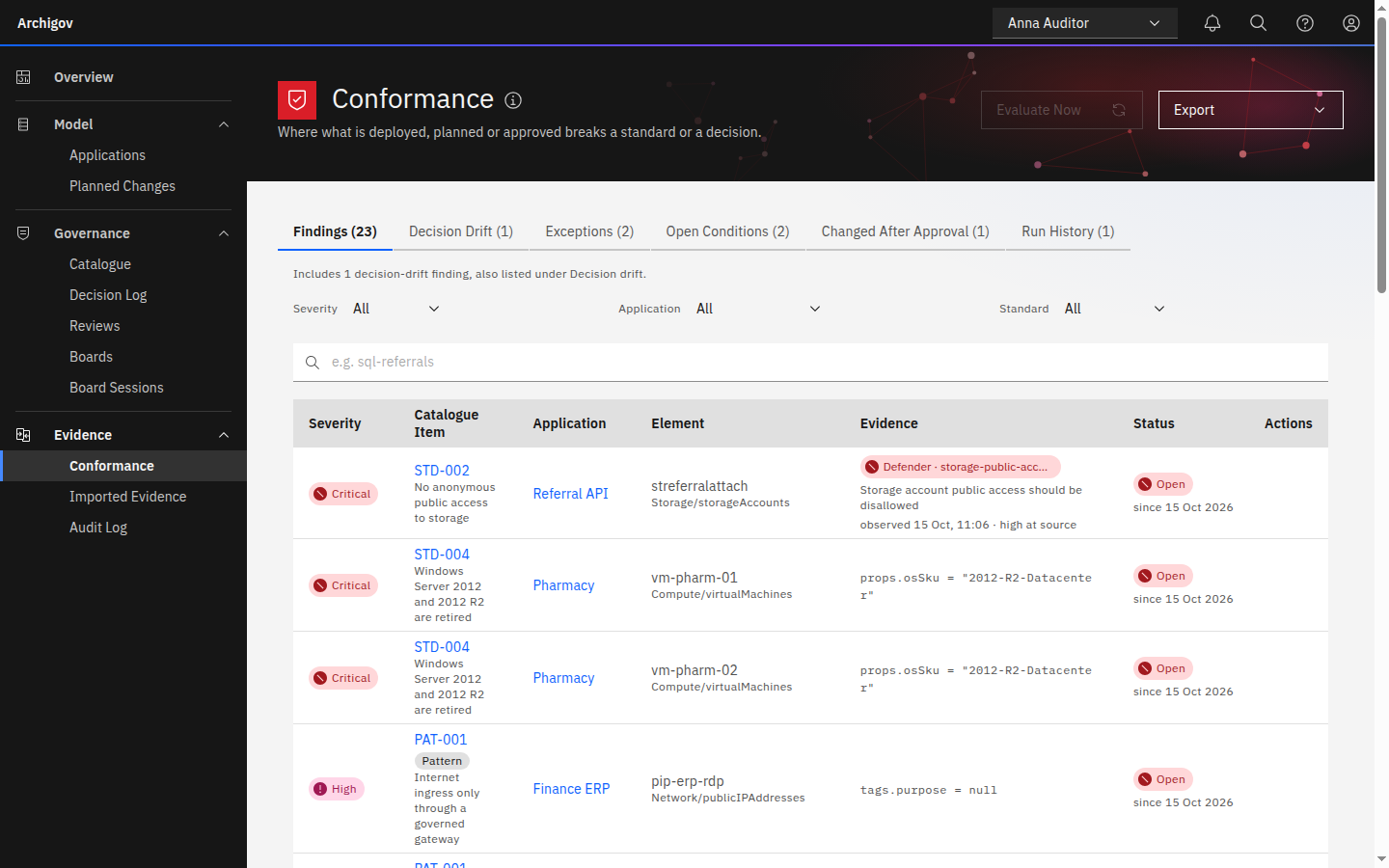
#When It Runs
- After every source sync (Azure, Defender, Policy, demo, imports).
- Hourly, on a scheduler.
- When an outcome takes effect (an artefact is adopted, a decision accepted, an exception granted).
- On demand, by anyone holding the pre-review right, or the platform admin.
Each evaluation is a run that stores the number of findings and a list of changes: what opened, what resolved, what reopened.
#Findings
A finding is keyed by a fingerprint — the artefact, the element and the application — so the same problem keeps the same finding across runs, with first seen and last seen dates. Every finding cites the artefact (or decision) it comes from and carries its evidence: the path, the expected and actual value, the imported evidence record, or the decision it contradicts.
| State | Meaning |
|---|---|
| Open | The condition holds now |
| Resolved | It no longer holds — fixed in the estate, or closed by a human |
| Excepted | An active exception covers it |
A human with the right to resolve findings (a board chair) can close a finding with a reason; the name and reason stay on the finding. If the condition still holds on the next run, the finding reopens and an audit row says so. Closing a finding never hides a real problem.
#Missing Evidence Is a Finding
A rule that asserts on imported evidence (op: evidence) and finds no evidence for a resource reports no evidence imported — never a pass. Absence of proof is not proof.
#Rule Errors Are Never Passes
An unknown operator or an invalid regular expression makes the rule an error: the run lists it under rule errors and the artefact shows it. A broken rule never counts as conforming.
#Exceptions
An exception excepts one artefact for an application or element, with a reason and an optional expiry. Exceptions are granted by a board — normally by approving an exception review on the Policy & Compliance Board — and every one is in the audit chain. When an exception expires, the finding comes back. The governance starter pack includes a policy that mandatory-policy exceptions carry an expiry.
#Other Signals
Beyond rule findings, Archigov surfaces — on the Conformance page, the Planned Changes page and the Overview pipeline:
- Decision drift — resources that contradict an accepted decision's constraint;
- Expired exceptions and overdue conditions;
- Changed after approval — work items whose requirements changed materially after their design was approved;
- Epics without a decision — planned change that needs an architecture decision and has none.
#Per-area Findings on a Review
On a review, each touched area shows the pre-review findings whose citations resolve to an artefact in that area's categories, so a decision maker sees the findings that concern them first.
Something unclear or out of date? Write to hello@archigov.com or open an issue on GitHub.