- Docs
- Concepts
Board Sessions
Sittings with a derived agenda, attendance, per-session delegation, quorum by area, a consent agenda, circulation, and minutes derived from the records.
#What a Session Is
A session (SES-0001) is one sitting of a board. Most of it is derived from the records, not authored: the agenda, the quorum, and the minutes. The secretary's notes are the only human-written part of the minutes.
planned → open → closed#Planning: The Derived Agenda
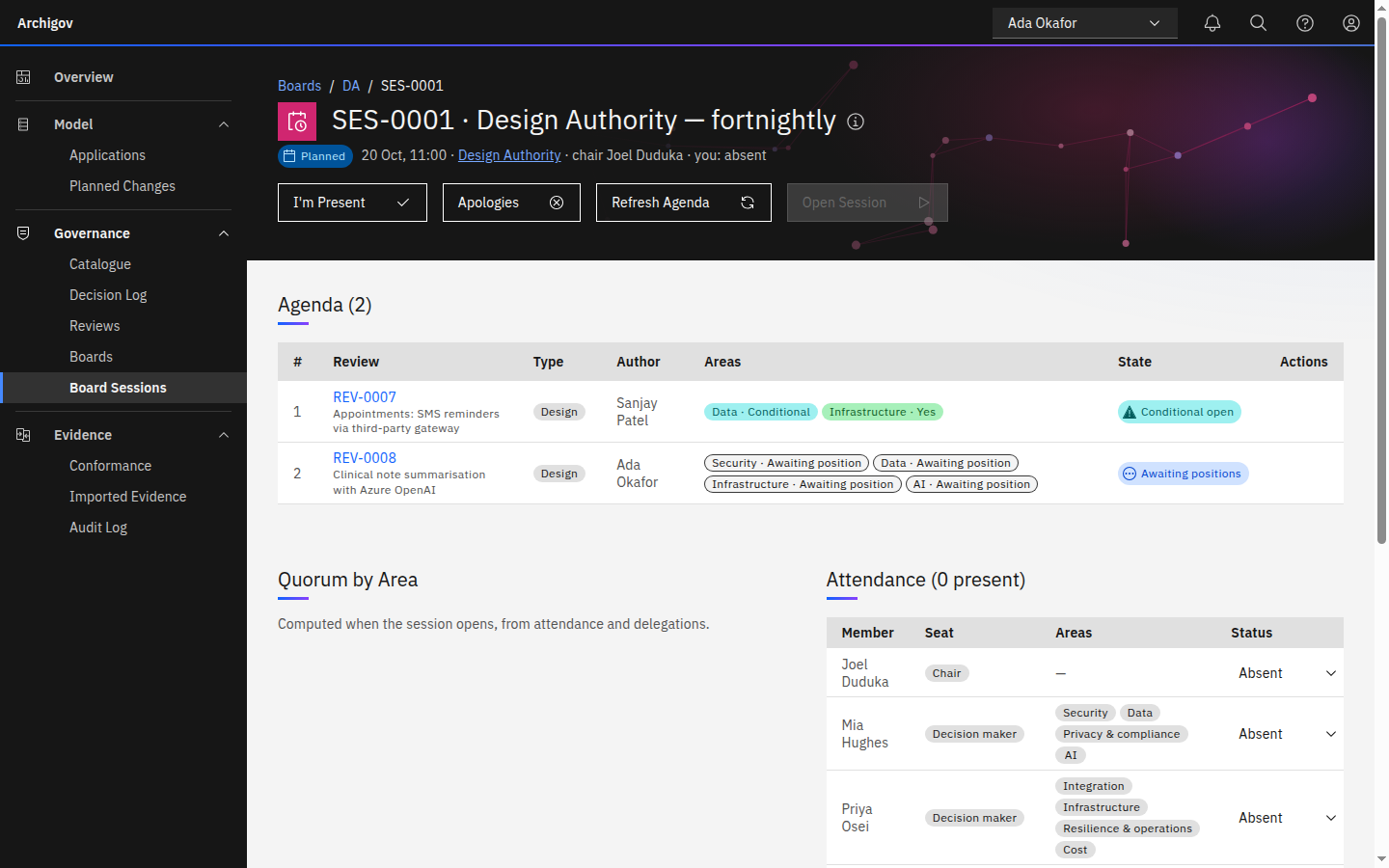
The chair or secretary creates a session with a date and an optional title. The agenda is derived from every review routed to the board that is still open and not already on another planned or open session:
- Ready items first — everything the chair could declare now.
- Then by deferral count (most-deferred first) and age.
Refresh Agenda adds newly eligible items. Items can be reordered or removed until they are declared. Circulation items are pulled in when they are overdue, or on request.
#Attendance and Delegation
- Every member is absent until recorded. Members record themselves present or send apologies; the chair or secretary can record anyone. Opening a session records the opener present; taking a position on an item in an open session records you present.
- A decision maker can delegate their seat for one session, for all or some of their areas. Delegation is one hop, recorded by the delegator (or by the secretary or chair on instruction, which is shown as such). It can never go to an auditor, a service account, or the author of an item on the agenda. The delegate becomes present on behalf of the seat.
#Quorum by Area
When the session opens, Archigov computes for each area whether an owner — or their delegate — is present. Uncovered areas are shown so the chair knows which items can be finished in the room and which will need circulation.
#Running the Sitting
When the chair opens the session:
- Items that are already ready move to the consent agenda. The chair can Pull any of them back into discussion, and Declare Consent Items approves the rest in one act — one audit row and one timeline event per item.
- For other items the chair calls the item, the room discusses it, owners record positions, the chair resolves conditionals and declares the outcome, or defers it with a reason.
- If the chair is the author of an item, they nominate an acting chair for it — a decision maker who is not the author.
#Circulation
When an area's owner is absent and undelegated, but every present owner is satisfied, the chair can declare approved subject to circulation with a due date. The absent owner records their position afterwards; when the last missing area says yes, the item becomes effective. A no in circulation sends the item back to in review and onto the next agenda.
#Closing and Minutes
On Close Session, every called item must be declared or deferred. Items listed but never reached are deferred automatically with the reason not reached. Archigov then derives the minutes:
- the board, date, chair, attendance, delegations and quorum;
- every item with its author, areas, each position by area (with delegation, text and resolution), the outcome, rationale, conditions and dependent decisions created, or the reason for deferral;
- the secretary's notes.
The minutes are hashed (SHA-256 over canonical JSON), the hash is written into the audit chain, and the session ships in the evidence pack. After closing, positions on items declared in the session are frozen (409 on change). Minutes are available as JSON and as rendered Markdown (Copy Markdown).
If the AI feature is enabled, the secretary can Draft Notes with AI from the session's own records. The minutes themselves always stay derived.
#Who Can Do What
| Act | Who |
|---|---|
| Create, refresh and reorder the agenda; record anyone's attendance; write notes | Chair or secretary of the board |
| Open and close; call, pull, defer, declare; resolve conditionals; nominate an acting chair | Chair (or the item's acting chair for that item) |
| Record own attendance | Any member with an acting seat |
| Delegate own seat | Decision makers |
| Read | Everyone, including auditors |
| Anything at all | Never the platform admin |
Note
Observers cannot record their own attendance, because the observer seat holds no capability; the secretary records them.
Something unclear or out of date? Write to hello@archigov.com or open an issue on GitHub.